ftUSD

Product Overview
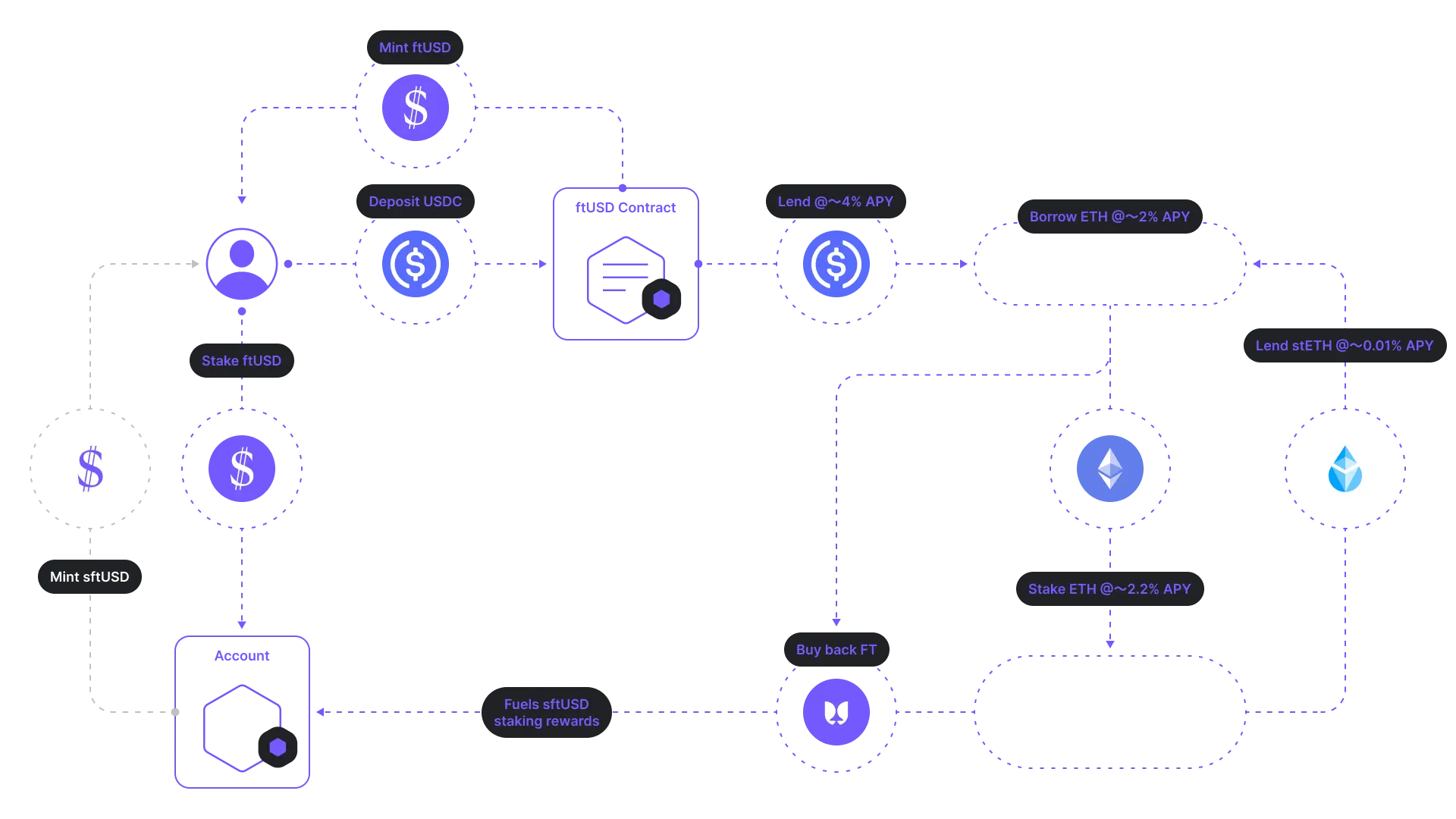
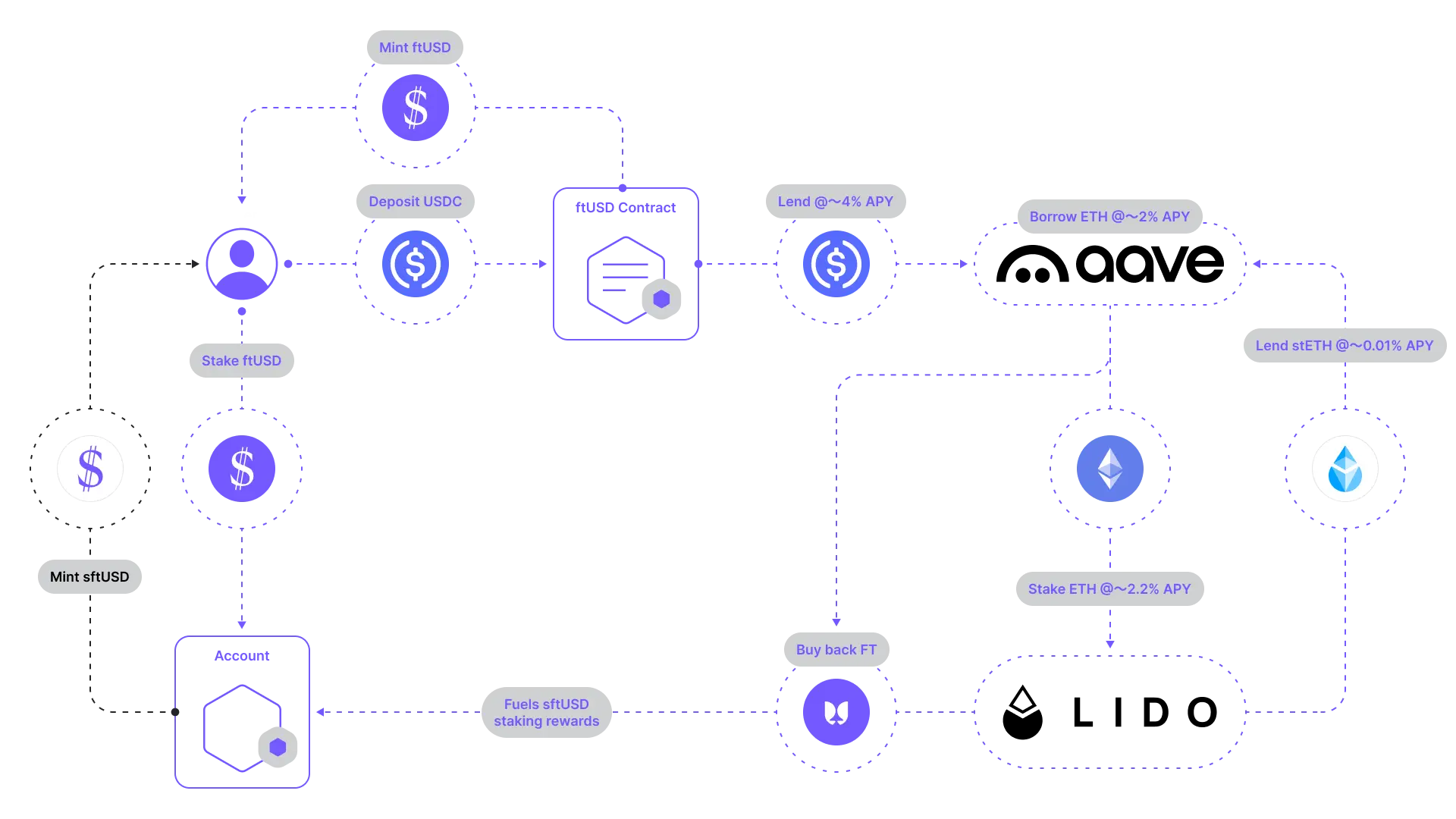
ftUSD and sftUSDsftUSDStaked ftUSD receipt token that accrues the staking pool’s yield in FT.View glossary entry lifecycle.
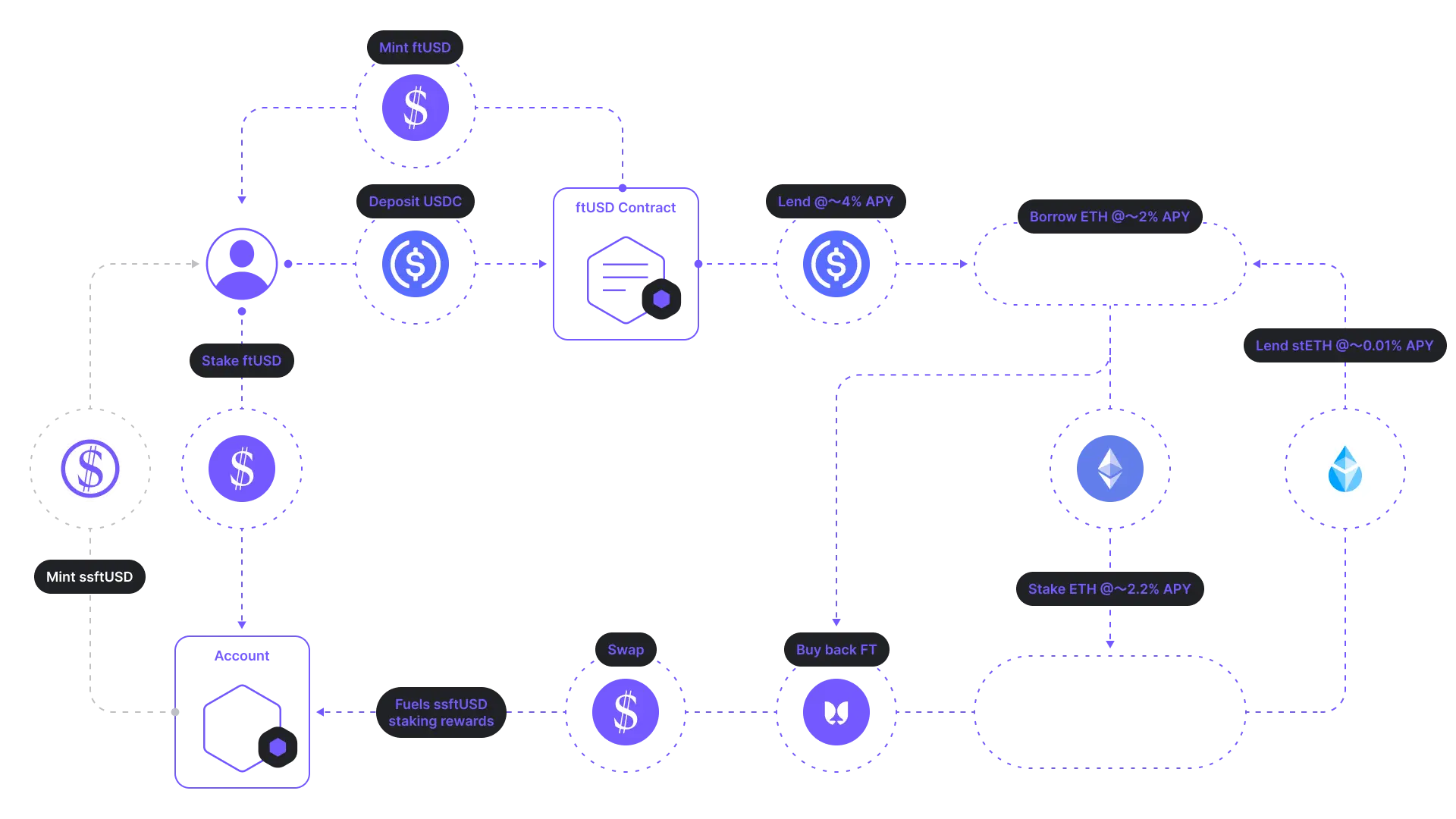
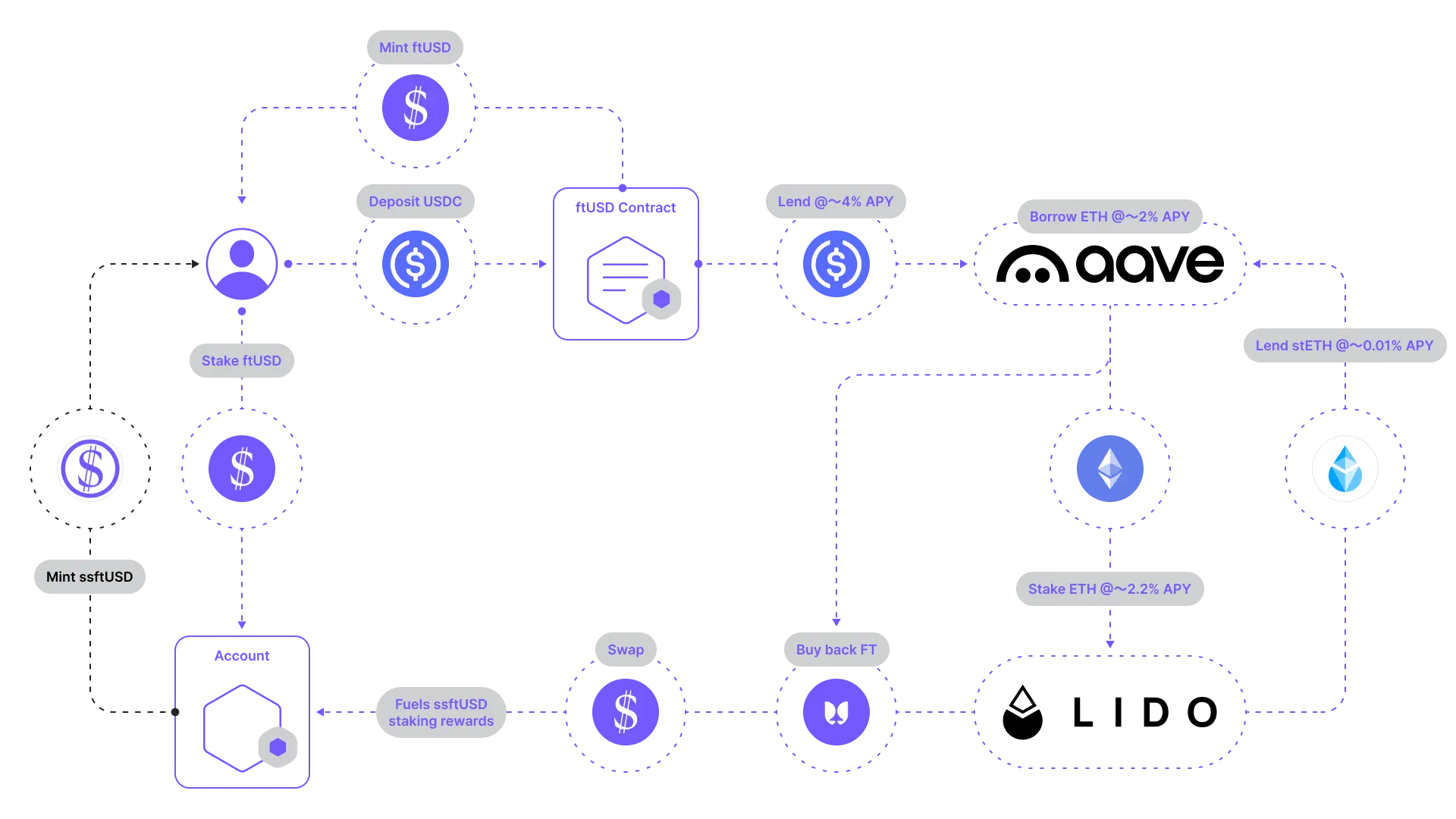
ftUSD and ssftUSDssftUSDStaked ftUSD receipt token that accrues the staking pool’s yield in ftUSD.View glossary entry lifecycle.
ftUSD is Flying Tulip's dollar‑pegged token designed for stability first, with optional yield when you choose to stake it as sftUSDsftUSDStaked ftUSD receipt token that accrues the staking pool’s yield in FT.View glossary entry or ssftUSDssftUSDStaked ftUSD receipt token that accrues the staking pool’s yield in ftUSD.View glossary entry. Unstaked ftUSD serves as a composable, on‑chain dollar across the ecosystem (trading, settlement, collateralcollateralAssets allowed as collateral and the maximum per‑asset size configured to manage concentration and risk.View glossary entry). If you want yield, you opt in by staking your ftUSD for sftUSDsftUSDStaked ftUSD receipt token that accrues the staking pool’s yield in FT.View glossary entry or ssftUSDssftUSDStaked ftUSD receipt token that accrues the staking pool’s yield in ftUSD.View glossary entry. Proceeds from unstaked ftUSD accrue to the protocol, helping fund operations and deepen liquidity; stakers receive the distributed yield. ftUSD, sftUSDsftUSDStaked ftUSD receipt token that accrues the staking pool’s yield in FT.View glossary entry, and ssftUSDssftUSDStaked ftUSD receipt token that accrues the staking pool’s yield in ftUSD.View glossary entry are fully on-chain, auditable, and transparent, with no oracles or centralized systems.
Note: ftUSD is stable and non‑yielding by default (great for payments, settlement, collateralcollateralAssets allowed as collateral and the maximum per‑asset size configured to manage concentration and risk.View glossary entry); sftUSDsftUSDStaked ftUSD receipt token that accrues the staking pool’s yield in FT.View glossary entry is staked and accrues yield in FT, ssftUSDssftUSDStaked ftUSD receipt token that accrues the staking pool’s yield in ftUSD.View glossary entry is also staked but auto-compounds.
Why choose ftUSD
- Stable unit of account. A $1‑target stable designed to act as the settlement currencysettlement currencyftUSD is used as the settlement currency; opt‑in LPs deposit ftUSD to settlement pools and accrue fees.View glossary entry across Flying Tulip (e.g., futures, order bookorder bookSee CLOB; orders can rest while deposits continue to accrue in the permissioned lending system.View glossary entry settlement, liquidity).
- Optional yield when you want it. Stake ftUSD to accrue distributed strategystrategyA yield venue tracked by the wrapper; strategies can be added/removed/reordered and capital moved between them by authorized roles.View glossary entry carry; keep ftUSD unstaked if you prefer pure stability or need immediate liquidity.
- Engineered for resilience. A delta‑neutraldelta‑neutralA portfolio whose net directional exposure is approximately zero, constructed by balancing long and short legs.View glossary entry architecture aims to reduce liquidationliquidationForced unwind of risky positions; Flying Tulip emphasizes gradual "soft" liquidations via Trade routing, with size/time‑slicing and keeper incentives.View glossary entry risk by balancing long/short legs and sizing positions conservatively.
- On‑chain transparency. CollateralCollateralAssets allowed as collateral and the maximum per‑asset size configured to manage concentration and risk.View glossary entry, parameters, and flows are visible and programmatic.
- Composability. Use ftUSD throughout the FT product suite: trade, settle, post as collateralcollateralAssets allowed as collateral and the maximum per‑asset size configured to manage concentration and risk.View glossary entry, or provide liquidity where available.
Note: Only staked ftUSD (sftUSDsftUSDStaked ftUSD receipt token that accrues the staking pool’s yield in FT.View glossary entry or ssftUSDssftUSDStaked ftUSD receipt token that accrues the staking pool’s yield in ftUSD.View glossary entry) accrues yield distributions.
How ftUSD works
ftUSD maintains its dollar target using balanced, delta‑neutraldelta‑neutralA portfolio whose net directional exposure is approximately zero, constructed by balancing long and short legs.View glossary entry strategies that combine conservative money markets and staking with offsetting short exposure. The aim is to generate a strategystrategyA yield venue tracked by the wrapper; strategies can be added/removed/reordered and capital moved between them by authorized roles.View glossary entry that carries (net of costs) while keeping net market exposure near zero.
Illustrative pipeline (one possible strategystrategyA yield venue tracked by the wrapper; strategies can be added/removed/reordered and capital moved between them by authorized roles.View glossary entry):
- Supply base collateralcollateralAssets allowed as collateral and the maximum per‑asset size configured to manage concentration and risk.View glossary entry to a money marketmoney marketA lending/borrowing venue where deposits accrue interest and loans are collateralized.View glossary entry (e.g., USDCUSDCStablecoins accepted in PCA contributions and used across products; each has distinct risk/peg mechanics.View glossary entry → AaveAaveA decentralized lending protocol used for conservative yield and collateralization in several Flying Tulip flows.View glossary entry) to accrue low‑risk interest.
- Borrow a hedging asset (e.g., Ethereum "ETH") against that collateralcollateralAssets allowed as collateral and the maximum per‑asset size configured to manage concentration and risk.View glossary entry, creating a short leg (you owe ETH).
- Stake the borrowed asset (e.g., ETH → stETHstETHA liquid‑staking representation of ETH used for conservative staking yield.View glossary entry via a staking venue) to accrue staking earnings = a long leg in stETHstETHA liquid‑staking representation of ETH used for conservative staking yield.View glossary entry.
- Loop collateralcollateralAssets allowed as collateral and the maximum per‑asset size configured to manage concentration and risk.View glossary entry prudently (e.g., deposit stETHstETHA liquid‑staking representation of ETH used for conservative staking yield.View glossary entry back to the money marketmoney marketA lending/borrowing venue where deposits accrue interest and loans are collateralized.View glossary entry) to increase safety buffers and carry.
The long (staked) side and the short (borrowed) side are sized to offset directional risk and reduce liquidationliquidationForced unwind of risky positions; Flying Tulip emphasizes gradual "soft" liquidations via Trade routing, with size/time‑slicing and keeper incentives.View glossary entry risk under typical conditions. Risk controlsRisk controlsGuardrails and procedures (e.g., regime detection, snapshot LTV, soft liquidation, size/time‑slicing, incentivized keepers) that aim to reduce tail risk and market impact.View glossary entry (position caps, rebalancing bands, and venue limits) constrain exposure.
Note: Exact venues, parameters, and chain support can change over time. The principle remains: delta‑neutraldelta‑neutralA portfolio whose net directional exposure is approximately zero, constructed by balancing long and short legs.View glossary entry construction + conservative sizing to target $1 while producing strategystrategyA yield venue tracked by the wrapper; strategies can be added/removed/reordered and capital moved between them by authorized roles.View glossary entry carry.
Staged roll-out
- Stage 0: Start with USDCUSDCStablecoins accepted in PCA contributions and used across products; each has distinct risk/peg mechanics.View glossary entry/USDTUSDTStablecoins accepted in PCA contributions and used across products; each has distinct risk/peg mechanics.View glossary entry to AaveAaveA decentralized lending protocol used for conservative yield and collateralization in several Flying Tulip flows.View glossary entry wrapper.
- Stage 1: Expand to FT Lend as it hardens.
- Stage 2: Add extra stablecoinstablecoinA token pegged to a reference value (e.g., USD). ftUSD is a stable, delta‑neutral, yield‑bearing variant.View glossary entry collateralcollateralAssets allowed as collateral and the maximum per‑asset size configured to manage concentration and risk.View glossary entry.
- Stage 3: Deploy delta-neutral on-chain yield.
- Stage 4: Deploy short funding delta-neutral strategystrategyA yield venue tracked by the wrapper; strategies can be added/removed/reordered and capital moved between them by authorized roles.View glossary entry (after perpetuals engine is live).
- Stage 5: Deploy covered call options selling delta-neutral strategystrategyA yield venue tracked by the wrapper; strategies can be added/removed/reordered and capital moved between them by authorized roles.View glossary entry (after options engine is live).
Buying ftUSD
- Open the Buy ftUSD screen.
- Choose your input asset (e.g., USDCUSDCStablecoins accepted in PCA contributions and used across products; each has distinct risk/peg mechanics.View glossary entry).
- Review the quote and confirm.
- Receive ftUSD in your wallet.
Note: Buying ftUSD does not start yield. To accrue yield, stake to sftUSDsftUSDStaked ftUSD receipt token that accrues the staking pool’s yield in FT.View glossary entry or ssftUSDssftUSDStaked ftUSD receipt token that accrues the staking pool’s yield in ftUSD.View glossary entry.
Selling ftUSD
- Convert ftUSD → input asset at the prevailing rate.
- Timing and any small exitexitAction that exercises the Perpetual PUT at par; the original asset/amount is returned.View glossary entryexitAction that exercises the Perpetual PUT at par; the original asset/amount is returned.View glossary entry/cooldown parameters are shown in‑app (subject to change with risk settings and network conditions).
Staking ftUSD → sftUSD or ssftUSD
Staking converts ftUSD into sftUSDsftUSDStaked ftUSD receipt token that accrues the staking pool’s yield in FT.View glossary entry or ssftUSDssftUSDStaked ftUSD receipt token that accrues the staking pool’s yield in ftUSD.View glossary entry, the yield‑accruing receipt token for the staking pool.
Staking quick flow
- Open Stake ftUSD.
- Enter the amount of ftUSD to stake.
- Confirm to receive sftUSDsftUSDStaked ftUSD receipt token that accrues the staking pool’s yield in FT.View glossary entry or ssftUSDssftUSDStaked ftUSD receipt token that accrues the staking pool’s yield in ftUSD.View glossary entry (your staked position).
How yield is delivered
For sftUSDsftUSDStaked ftUSD receipt token that accrues the staking pool’s yield in FT.View glossary entry:
- sftUSDsftUSDStaked ftUSD receipt token that accrues the staking pool’s yield in FT.View glossary entry represent your staked position in the rewards vault.
- Net strategystrategyA yield venue tracked by the wrapper; strategies can be added/removed/reordered and capital moved between them by authorized roles.View glossary entry yield and protocol fees are collected by the treasury and distributed to stakers.
- Stakers claim rewards as FT from the rewards vault.
Note: sftUSDsftUSDStaked ftUSD receipt token that accrues the staking pool’s yield in FT.View glossary entry rewards do not auto-compound. Rewards should be claimed as FT from the rewards vault.
For ssftUSDssftUSDStaked ftUSD receipt token that accrues the staking pool’s yield in ftUSD.View glossary entry:
- ssftUSDssftUSDStaked ftUSD receipt token that accrues the staking pool’s yield in ftUSD.View glossary entry represent your staked position in the rewards vault.
- Net strategystrategyA yield venue tracked by the wrapper; strategies can be added/removed/reordered and capital moved between them by authorized roles.View glossary entry yield and protocol fees are collected by the treasury and distributed to stakers.
- Stakers do not claim rewards, they are distributed as ftUSD automatically.
Note: ssftUSDssftUSDStaked ftUSD receipt token that accrues the staking pool’s yield in ftUSD.View glossary entry rewards auto-compound. Rewards are distributed as ftUSD.
Note: ssftUSDssftUSDStaked ftUSD receipt token that accrues the staking pool’s yield in ftUSD.View glossary entry receives slightly less rewards than sftUSDsftUSDStaked ftUSD receipt token that accrues the staking pool’s yield in FT.View glossary entry to encourage FT ecosystem support.
Unstaking
- Convert sftUSDsftUSDStaked ftUSD receipt token that accrues the staking pool’s yield in FT.View glossary entry or ssftUSDssftUSDStaked ftUSD receipt token that accrues the staking pool’s yield in ftUSD.View glossary entry → ftUSD at the prevailing rate.
- Timing and any small exitexitAction that exercises the Perpetual PUT at par; the original asset/amount is returned.View glossary entry/cooldown parameters are shown in‑app (subject to change with risk settings and network conditions).
Note: Unstaked ftUSD receives no yield; proceeds accrue to the protocol treasury. Staked ftUSD receives distributed yield from ftUSD strategies.
Yield sources
ftUSD yield is generated from a mix of strategystrategyA yield venue tracked by the wrapper; strategies can be added/removed/reordered and capital moved between them by authorized roles.View glossary entrystrategyA yield venue tracked by the wrapper; strategies can be added/removed/reordered and capital moved between them by authorized roles.View glossary entry yield on collateralcollateralAssets allowed as collateral and the maximum per‑asset size configured to manage concentration and risk.View glossary entrycollateralAssets allowed as collateral and the maximum per‑asset size configured to manage concentration and risk.View glossary entry and protocol revenue. The on-chain strategies currently implemented are stablecoinstablecoinA token pegged to a reference value (e.g., USD). ftUSD is a stable, delta‑neutral, yield‑bearing variant.View glossary entry lending via AaveAaveA decentralized lending protocol used for conservative yield and collateralization in several Flying Tulip flows.View glossary entry1 and stablecoin saving via Spark2; other optional modules are planned.
Strategy yield
- StablecoinStablecoinA token pegged to a reference value (e.g., USD). ftUSD is a stable, delta‑neutral, yield‑bearing variant.View glossary entry lending (implemented): supply stablecoinstablecoinA token pegged to a reference value (e.g., USD). ftUSD is a stable, delta‑neutral, yield‑bearing variant.View glossary entry collateralcollateralAssets allowed as collateral and the maximum per‑asset size configured to manage concentration and risk.View glossary entry to a lending market (e.g., USDCUSDCStablecoins accepted in PCA contributions and used across products; each has distinct risk/peg mechanics.View glossary entry/USDTUSDTStablecoins accepted in PCA contributions and used across products; each has distinct risk/peg mechanics.View glossary entry into AaveAaveA decentralized lending protocol used for conservative yield and collateralization in several Flying Tulip flows.View glossary entry) to earn interest.
- Lending-based delta-neutral carry (implemented): use stablecoinstablecoinA token pegged to a reference value (e.g., USD). ftUSD is a stable, delta‑neutral, yield‑bearing variant.View glossary entrystablecoinA token pegged to a reference value (e.g., USD). ftUSD is a stable, delta‑neutral, yield‑bearing variant.View glossary entry collateralcollateralAssets allowed as collateral and the maximum per‑asset size configured to manage concentration and risk.View glossary entry in a lending market to borrow native network asset, wrap it into a staking asset, and earn net carry when
(staking yield + staking rewards) - (native borrow cost) > 0. - Crypto-collateralcollateralAssets allowed as collateral and the maximum per‑asset size configured to manage concentration and risk.View glossary entrycollateralAssets allowed as collateral and the maximum per‑asset size configured to manage concentration and risk.View glossary entry carry (implemented): deposit a yield-bearing crypto asset (e.g., staked ETH), borrow equivalent native (ETH), sell to USD, and deploy the USD for yield; target
(USD yield + native yield + staking yield) - (native borrow cost) > 0. - CDP-style minting (roadmap): allow multi-collateralcollateralAssets allowed as collateral and the maximum per‑asset size configured to manage concentration and risk.View glossary entry minting, with a variable interest rate driven by supply/demand (utilizationutilizationThe share of a pool’s assets that are currently borrowed or in active use.View glossary entry) on the lending layer.
- Peg keeper module (roadmap): sell when ftUSD trades above net asset value (NAV) and buy when below, capturing arbitrage profits.
- CFD/perp carry (roadmap): use staking assets as collateralcollateralAssets allowed as collateral and the maximum per‑asset size configured to manage concentration and risk.View glossary entry and hold a 1x native short to earn positive funding/carry when available.
Protocol fees
- Money‑market interest (e.g., AaveAaveA decentralized lending protocol used for conservative yield and collateralization in several Flying Tulip flows.View glossary entry supply APRs for stablecoins or LSTLSTA tokenized claim on staked assets that remains liquid (e.g., stETH).View glossary entry collateralcollateralAssets allowed as collateral and the maximum per‑asset size configured to manage concentration and risk.View glossary entry).
- Staking earnings (e.g., stETHstETHA liquid‑staking representation of ETH used for conservative staking yield.View glossary entry) on the long leg.
Distribution to stakers
All net strategystrategyA yield venue tracked by the wrapper; strategies can be added/removed/reordered and capital moved between them by authorized roles.View glossary entry yield and protocol fee revenue is collected by the protocol treasury; then at treasury discretion distributed via buyback-and-distribute to ftUSD stakers.
Comparative benchmarks (snapshot)
Rates that drive the strategies are shown in strategystrategyA yield venue tracked by the wrapper; strategies can be added/removed/reordered and capital moved between them by authorized roles.View glossary entrystrategyA yield venue tracked by the wrapper; strategies can be added/removed/reordered and capital moved between them by authorized roles.View glossary entry breakdown table.
Benefits at a glance
- Optionality: Hold ftUSD for pure stability, or stake to sftUSDsftUSDStaked ftUSD receipt token that accrues the staking pool’s yield in FT.View glossary entry or ssftUSDssftUSDStaked ftUSD receipt token that accrues the staking pool’s yield in ftUSD.View glossary entry to accrue protocol distributions.
- Lower operational burden: Yield routing and rebalancing are handled on‑chain; staking is one click.
- Ecosystem native: ftUSD is the settlement currencysettlement currencyftUSD is used as the settlement currency; opt‑in LPs deposit ftUSD to settlement pools and accrue fees.View glossary entry across futures and other markets; widely usable as collateralcollateralAssets allowed as collateral and the maximum per‑asset size configured to manage concentration and risk.View glossary entry/liquidity.
- Risk‑aware design: Delta‑neutralDelta‑neutralA portfolio whose net directional exposure is approximately zero, constructed by balancing long and short legs.View glossary entry construction with sizing bands and venue caps to reduce common liquidationliquidationForced unwind of risky positions; Flying Tulip emphasizes gradual "soft" liquidations via Trade routing, with size/time‑slicing and keeper incentives.View glossary entry paths.
Risks
- Peg and basisbasisThe long/short spread or periodic payments that keep derivative prices aligned with spot (used in delta‑neutral strategies and futures).View glossary entry risk: Severe market moves can widen basisbasisThe long/short spread or periodic payments that keep derivative prices aligned with spot (used in delta‑neutral strategies and futures).View glossary entry or stress hedges; the $1 target can deviate.
- Venue risk: Money markets, staking, and external protocols carry smart‑contract and validator risks.
- Liquidity/exitexitAction that exercises the Perpetual PUT at par; the original asset/amount is returned.View glossary entry timing: Staked assets (LSTs) may require queuesqueuesWaiting periods required to withdraw from certain staking positions (e.g., stETH withdrawals, SOL/AVAX unbonding).View glossary entry; large rebalances can take time.
- Parameter risk: StrategyStrategyA yield venue tracked by the wrapper; strategies can be added/removed/reordered and capital moved between them by authorized roles.View glossary entry weights, caps, and rebalancing rules can change as risk conditions change.
Note: Read Risks, Security & Audits for a full discussion of general DeFiDeFiFinancial services built on public blockchains using smart contracts rather than centralized intermediaries.View glossary entry risks and capital‑allocation specifics.
FAQs
Does ftUSD pay interest automatically?
No. ftUSD is non‑yielding by default. To accrue yield, stake to sftUSDsftUSDStaked ftUSD receipt token that accrues the staking pool’s yield in FT.View glossary entry or ssftUSDssftUSDStaked ftUSD receipt token that accrues the staking pool’s yield in ftUSD.View glossary entry.
What's the difference between ftUSD, sftUSDsftUSDStaked ftUSD receipt token that accrues the staking pool’s yield in FT.View glossary entry, and ssftUSDssftUSDStaked ftUSD receipt token that accrues the staking pool’s yield in ftUSD.View glossary entry?
ftUSD is the base stable (target $1). sftUSDsftUSDStaked ftUSD receipt token that accrues the staking pool’s yield in FT.View glossary entry and ssftUSDssftUSDStaked ftUSD receipt token that accrues the staking pool’s yield in ftUSD.View glossary entry are the staked receipts that accrues protocol distributions tied to ftUSD strategies.
What's the difference between sftUSDsftUSDStaked ftUSD receipt token that accrues the staking pool’s yield in FT.View glossary entry and ssftUSDssftUSDStaked ftUSD receipt token that accrues the staking pool’s yield in ftUSD.View glossary entry?
sftUSDsftUSDStaked ftUSD receipt token that accrues the staking pool’s yield in FT.View glossary entry accrues rewards in FT. These reward should be claimed by staker. ssftUSDssftUSDStaked ftUSD receipt token that accrues the staking pool’s yield in ftUSD.View glossary entry accrues rewards in ftUSD. These rewards auto-compound.
How is the ftUSD peg maintained?
By constructing delta‑neutraldelta‑neutralA portfolio whose net directional exposure is approximately zero, constructed by balancing long and short legs.View glossary entry positions (balanced long/short) with conservative sizing and rebalancing controls. This reduces exposure to directional market moves.
Can I use ftUSD across the protocol?
Yes. ftUSD is designed as the settlement currencysettlement currencyftUSD is used as the settlement currency; opt‑in LPs deposit ftUSD to settlement pools and accrue fees.View glossary entry and a common collateralcollateralAssets allowed as collateral and the maximum per‑asset size configured to manage concentration and risk.View glossary entry across the product suite; availability varies by feature and chain.
Where can I see rates and history?
The Stake UIUIThe visual interface through which users interact with an app or product.View glossary entry shows current pool stats (e.g., exchange rate, historical performance). Rates are variable and not guaranteed.
Is ftUSD just a USDCUSDCStablecoins accepted in PCA contributions and used across products; each has distinct risk/peg mechanics.View glossary entry/USDTUSDTStablecoins accepted in PCA contributions and used across products; each has distinct risk/peg mechanics.View glossary entry to AaveAaveA decentralized lending protocol used for conservative yield and collateralization in several Flying Tulip flows.View glossary entry wrapper?
At launch, ftUSD is a USDCUSDCStablecoins accepted in PCA contributions and used across products; each has distinct risk/peg mechanics.View glossary entry/USDTUSDTStablecoins accepted in PCA contributions and used across products; each has distinct risk/peg mechanics.View glossary entry to AaveAaveA decentralized lending protocol used for conservative yield and collateralization in several Flying Tulip flows.View glossary entry wrapper (Stage 0). It expands through the staged roll-out above.
Is the ftUSD/USDCUSDCStablecoins accepted in PCA contributions and used across products; each has distinct risk/peg mechanics.View glossary entry (ftUSD/USDTUSDTStablecoins accepted in PCA contributions and used across products; each has distinct risk/peg mechanics.View glossary entry) pool just a Uniswap v3-style CLMM?
Yes. The ftUSD/USDCUSDCStablecoins accepted in PCA contributions and used across products; each has distinct risk/peg mechanics.View glossary entry (ftUSD/USDTUSDTStablecoins accepted in PCA contributions and used across products; each has distinct risk/peg mechanics.View glossary entry) AMMAMMOn‑chain market using formulas instead of a central order book to quote prices and execute swaps.View glossary entry uses a standard Uniswap v3-style CLMM as a security consideration.
Is ftUSD available as collateralcollateralAssets allowed as collateral and the maximum per‑asset size configured to manage concentration and risk.View glossary entry on Lend? It is possible to confirm on Lend directly.
Related pages
- FT Token: how value flows into FT via buyback-and-burnbuyback-and-burnA mechanism that buys FT on the open market and sends it to an irrecoverable address, permanently reducing supply. May be funded by backing capital yield surplus, protocol revenue/fees, or released backing capital from withdrawals.View glossary entry
- Capital Allocation: mechanics, Perpetual PUTPerpetual PUTThe on-chain right attached to primary-issued FT that lets a holder: Hold (keep the FT NFT attached), Exit (Exit at par; return collateral), or Withdraw (unlock FT; invalidate the PUT; released backing capital can fund market buyback-and-burn of FT).View glossary entry lifecycle
- Risks, Security & Audits: risk framework and controls